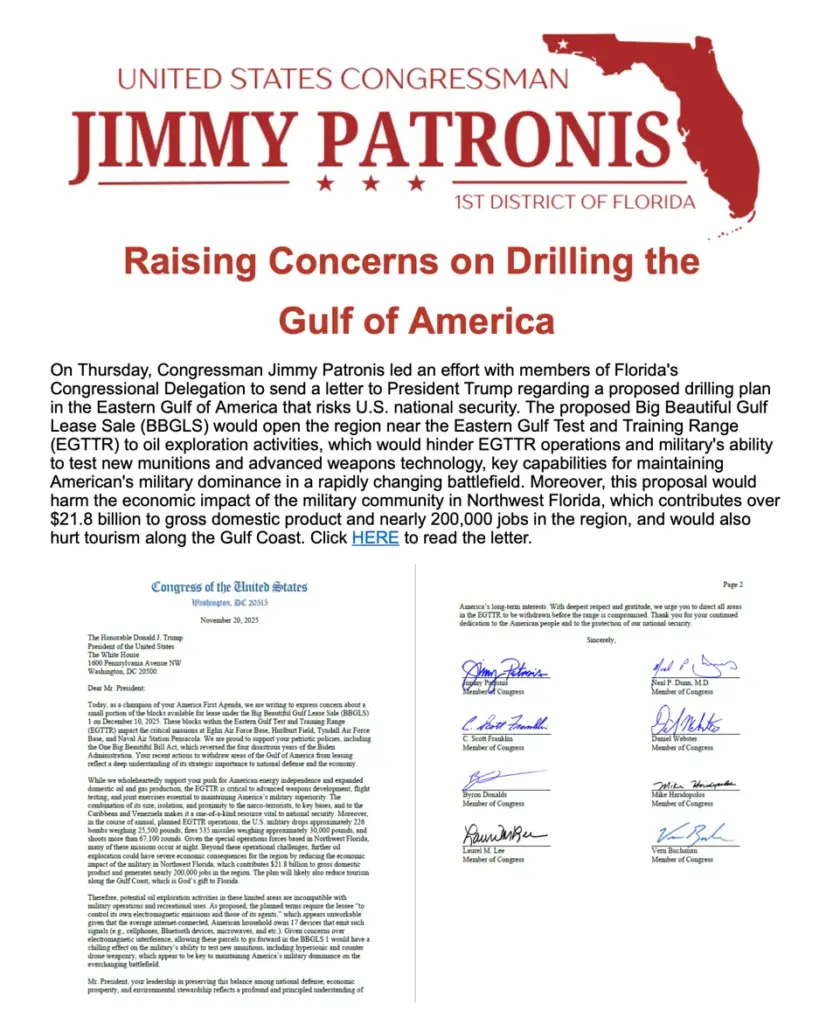
The Military Mission Line
A single line on a map protects the only place in America where the military can fully test the weapons it needs to stay ahead of a rising threat — and it’s now under federal review.
Why the Military Mission Line Exists
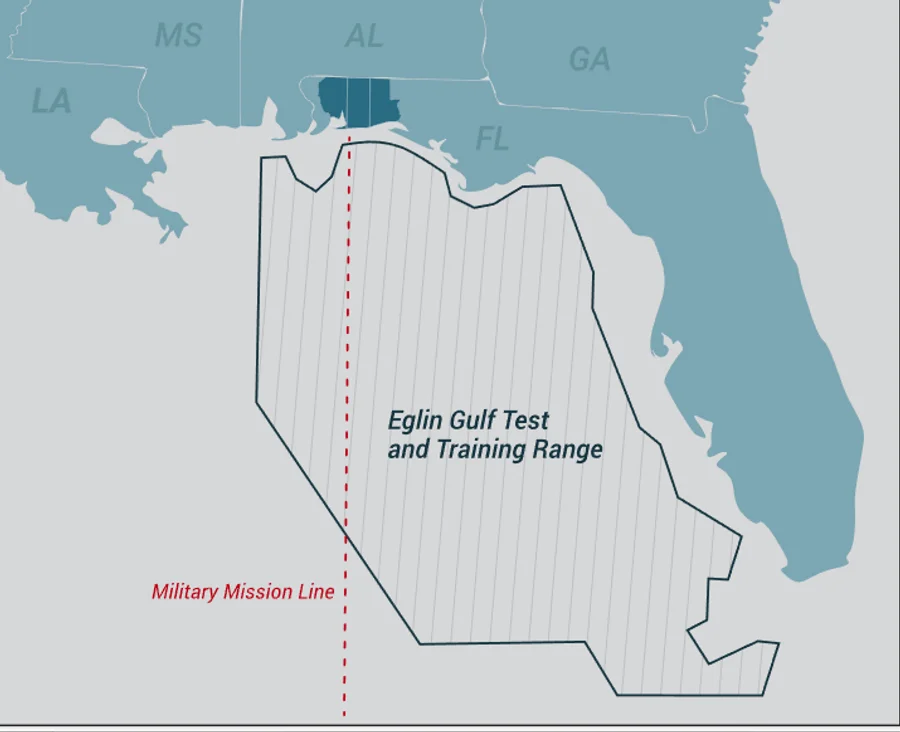
The Military Mission Line (MML) exists solely due to Executive Order and needs to be codified in U.S. law to protect critical test and evaluation areas. These areas in the Gulf of America ensure National Security by providing the only Operationally Representative geographic spaces to stress cutting edge weapons that are expanding in speed and range to defeat a rising threat. U.S. leaders have a crucial decision to balance National Security with opposing Department of Interior (DOI) and Department of War (DOW) requirements. Unfortunately, a decision through the lens of economic value will lead to a short-sighted policy to allow drilling in critical areas, leading to the end of robust and efficient weapons testing required to maintain military dominance.
A Moratorium Under Threat
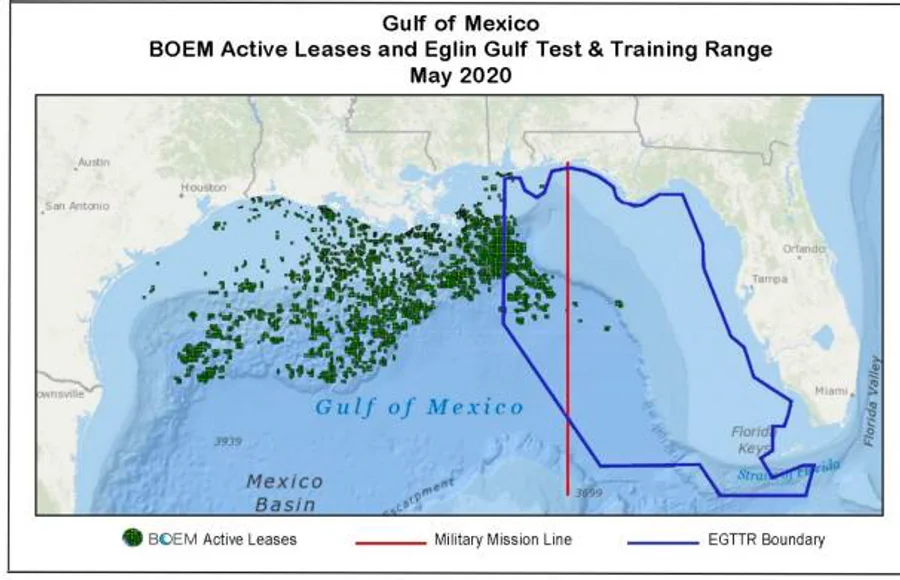
The Gulf of Mexico Energy Security Act of 2006 placed a moratorium until 2022 on leasing activities east of the MML. While the Biden Administration’s 2024–2029 National Outer Continental Shelf Oil and Gas Leasing Program extended this moratorium, DOI’s “Unleashing American Offshore Energy” plans to terminate restrictions, and the Bureau of Ocean Energy Management (BOEM) released a draft plan that includes the sale of potential oil leases in the Eastern half of the Gulf of America. If approved, this plan would end weapons testing in the Eastern Gulf Test and Training Range, also known as the Eglin Gulf Test and Training Range (EGTTR), which DOW stated cannot be replicated anywhere else in the United States.
Why the EGTTR Can’t Be Replicated Anywhere Else
The EGTTR connects test and training capabilities across the eastern Gulf of America from Key West to Northwest Florida with 180,000 square miles of controlled airspace and 17 miles of shoreline access. This area provides unique spaces to fly the DOW’s only Full-Scale Aerial Targets (FSAT) and robust Subscale Aerial Targets (SSAT), and recent Gulf Range Enhancements (GRE) improve Telemetry (TM) data capture and analysis capability along the Florida coastline to track and analyze cutting edge weapons in realistic combat-surrogate conditions. The increasing speed and range of weapons required to defeat China make the EGTTR the only suitable space to qualify new weapons and ensure our warfighters maintain the advantage over the adversary. In addition, the co-location of both Developmental Test (DT) and Operational Test (OT) fighters as well as the Armament Directorate Headquarters at Eglin AFB allow for efficient and low-cost weapons testing with easy access to the EGTTR. Next, the water-to-land combination of military ranges is the only place to qualify navigation and guidance modes of weapons transition from ocean to land flight. Finally, surface and subsurface employment and space recoveries rely upon the unique area provided by the Gulf of America, with persistent unpopulated and safe air and surface landscape to conduct operations with minimal to no impact to U.S. citizens.
What’s at Stake
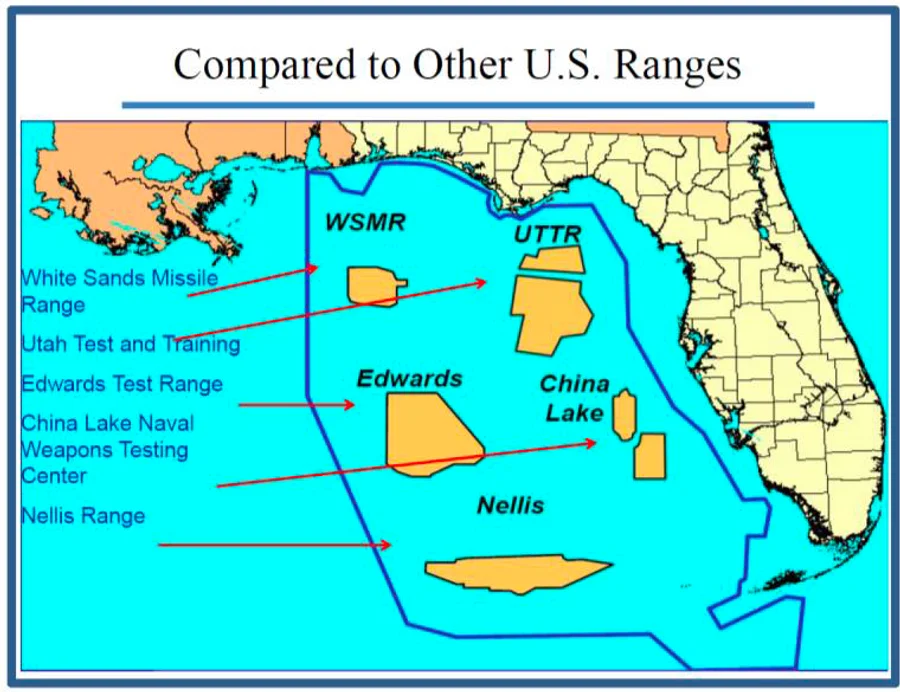
Oil drilling structures, exploratory activities, and wind turbine infrastructure would be incompatible with military activities, thus ending an exclusively utilized military area with no substitute available. The EGTTR is large enough to encompass all other U.S. weapons testing ranges put together, and it is still challenged to contain the employment ranges of next generation weapons. Ending the moratorium would curtail one of the precious resources the United States maintains to ensure National Security by robust weapons evaluations. Without these critical weapons evaluations in a full operationally representative environment, our nations’ warfighters may be forced to employ weapons in future combat actions that were never operationally tested at maximum capability.
ECMAC is engaging with congressional leaders to keep the Military Mission Line protected.